early in the story, late November morning
Prince Myshkin's Arrival and Meeting with Rogozhin

Prince Lef Nicolaievitch Muishkin, a young man returning to Russia after four years in Switzerland for treatment of epilepsy, meets Parfen Rogojin in a third-class railway carriage on the Warsaw and Petersburg Railway approaching St. Petersburg. The prince is poorly dressed, carrying only a bundle, and speaks with naive candor about his illness and his poverty. Rogojin, the son of a recently deceased millionaire merchant, is agitated and feverish, having just returned from Pskoff after a quarrel with his father over the beautiful Nastasia Philipovna Barashkoff. Rogojin tells the prince of his infatuation with Nastasia, how he bought her diamond earrings with his father's money, and how his father later humiliated himself to get them back. The encounter establishes the deep, fateful connection between the two men, as Rogojin impulsively invites the prince to visit him and promises to buy him fine clothes. The scene introduces the novel's central themes of innocence, passion, and the collision of social extremes.
later the same morning
Myshkin's First Visit to the Epanchin Family

The prince arrives at the home of General Ivan Fedorovitch Epanchin, a wealthy and influential businessman. After a confusing encounter with the suspicious footman, the prince is admitted and meets the general, who is initially dismissive but becomes intrigued by the prince's honesty and his remarkable calligraphy. The general offers the prince a small sum of money and arranges for him to lodge with the Ivolgin family. The prince then meets the general's wife, Lizabetha Prokofievna, and their three daughters: Alexandra, Adelaida, and the beautiful and capricious Aglaya. During lunch, the prince tells the story of his life in Switzerland, his love for children, and his profound reflections on capital punishment, which he witnessed in Lyons. His simple, sincere manner and his philosophical observations captivate the women, though Aglaya mocks him. The visit establishes the prince's place as a strange but fascinating figure in the Epanchin household.
later that morning, in General Epanchin's study
Gania's Dilemma and Nastasia's Portrait
In the general's study, Gavrila Ardalionovitch Ivolgin (Gania) shows the general a photograph of Nastasia Philipovna, which she gave him that day. The general reveals that Nastasia has promised to give a final answer that evening about whether she will marry Gania, a match promoted by Totski and the general for their own interests. Gania is visibly agitated, torn between his desire for the seventy-five thousand roubles that would come with the marriage and his pride. The prince, who has been writing a sample of his calligraphy, sees the portrait and is deeply struck by Nastasia's beauty and the suffering he reads in her face. He remarks that her destiny is not ordinary and that she must have suffered terribly. Gania, suspicious and hostile, asks the prince if he would marry such a woman, and the prince replies that he cannot marry at all due to his illness. The scene foreshadows the prince's profound connection to Nastasia and the conflict that will engulf him.
later that morning, in the Epanchin drawing-room
Myshkin Meets the Epanchin Ladies
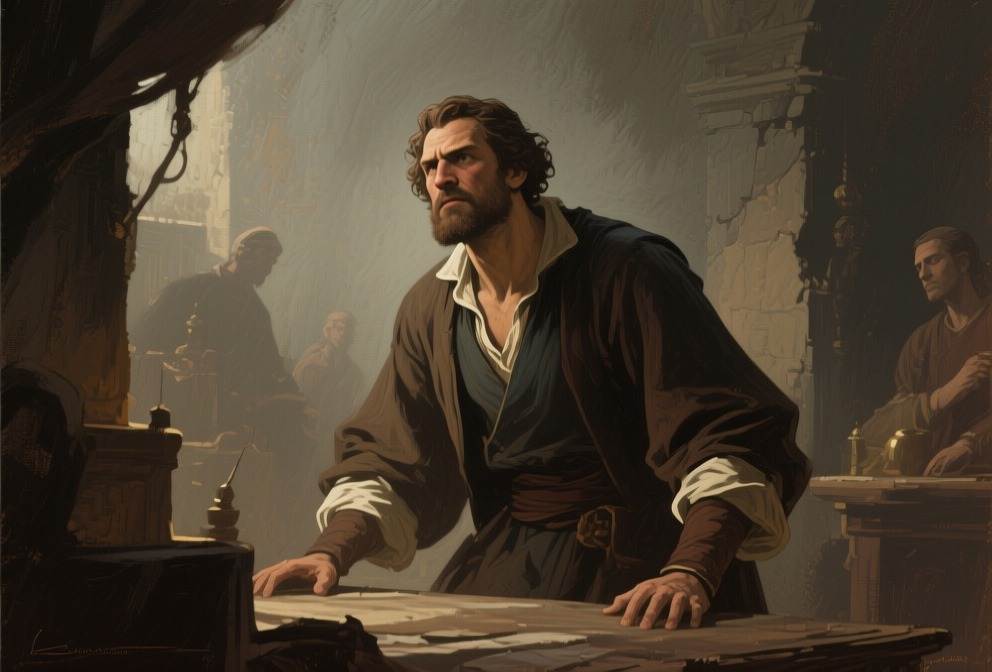
The prince is summoned to meet Lizabetha Prokofievna and her daughters. Mrs. Epanchin, initially suspicious of the prince's shabby appearance, is won over by his gentle manners and his intelligent, if naive, conversation. The prince tells them about his life in Switzerland, his love for donkeys, and his profound reflections on the nature of happiness and the fear of death. He recounts the story of a man who was reprieved from execution and describes the psychological torment of the condemned. The conversation turns to the subject of beauty, and the prince declares that he has seen an execution and that it left a terrible impression on him. Aglaya mocks him, but the family is increasingly fascinated by his unique perspective. The prince also reads their faces, telling Adelaida she has a happy face, Alexandra a sorrowful one, and Mrs. Epanchin that she is a child at heart. The visit solidifies the prince's place as an object of curiosity and affection in the household.
afternoon of the first day
Myshkin Moves into the Ivolgin House
Following General Epanchin's recommendation, the prince takes up lodging in the Ivolgin family's flat. He is shown to his room by Colia Ivolgin, Gania's younger brother, and meets the rest of the household: Nina Alexandrovna, the long-suffering mother; Varvara Ardalionovna, the proud and practical sister; and the eccentric General Ardalion Alexandrovitch Ivolgin, the father, who is a boastful, alcoholic former officer. The prince also encounters Ferdishenko, a coarse and cynical lodger, and later the general himself, who claims to have known the prince's father and tells fantastic stories. The atmosphere is tense, as the family is divided over Gania's impending marriage to Nastasia Philipovna, which they consider a disgrace. The prince's presence adds a new, unpredictable element to the household's strained dynamics.
late afternoon of the first day
Nastasia's Unexpected Visit to the Ivolgins
Nastasia Philipovna arrives unannounced at the Ivolgin house, causing a sensation. She is in a mocking, provocative mood, and her presence throws the family into chaos. She insults Gania, flirts with his father, and makes cutting remarks about the family's poverty and pretensions. The scene escalates when Rogojin and his rowdy band of followers burst in, offering Nastasia first eighteen thousand, then forty thousand, and finally a hundred thousand roubles to leave Gania and come with him. Nastasia taunts Gania and his family, reveling in the scandal. In the ensuing chaos, Gania's sister Varvara spits in his face, and Gania, in a rage, tries to strike her but is stopped by the prince. Gania then slaps the prince across the face. The prince, pale and trembling, forgives him, saying, "Oh, how ashamed you will be of this afterwards!" Nastasia, moved by the prince's Christ-like response, kisses Nina Alexandrovna's hand before leaving with Rogojin.
evening of the first day, at Nastasia's flat
Nastasia's Birthday Party Fire Scene

At Nastasia Philipovna's birthday party, a small gathering of her acquaintances including Totski, General Epanchin, Gania, Ptitsin, Ferdishenko, and the prince, the atmosphere is tense. Nastasia is in a hysterical, reckless mood. She announces that she will decide Gania's fate that evening. The party is interrupted by Rogojin, who arrives with a hundred thousand roubles, which he places on the table. Nastasia, in a fit of defiant self-destruction, declares that she will not marry Gania and that she is free. She then turns to the prince, who has just revealed that he has inherited a large fortune, and he offers to marry her. Nastasia, moved but ultimately refusing to ruin him, decides to go with Rogojin. In a final, spectacular act, she throws the packet of a hundred thousand roubles into the fire, telling Gania that if he retrieves it with his bare hands, it will be his. Gania, after a moment of agonized hesitation, faints. Nastasia then pulls the money from the fire with the tongs, gives it to Gania, and leaves with Rogojin.
two days after Nastasia's birthday party
Myshkin's Departure for Moscow
Prince Muishkin hurriedly leaves St. Petersburg for Moscow to attend to the legal matters concerning his unexpected inheritance. His departure is sudden and mysterious, and he is absent for six months. During this time, rumors circulate about his fortune and his relationship with Nastasia Philipovna, who has also disappeared, first with Rogojin and then on her own. The Epanchin family, initially offended by the prince's behavior, gradually becomes preoccupied with other matters, including Adelaida's engagement to Prince S. and the appearance of Evgenie Pavlovitch Radomski as a potential suitor for Aglaya. The prince's absence allows the other characters to develop their own plots and relationships, setting the stage for his eventual return.
six months later, early June
Myshkin's Return to St. Petersburg
Prince Muishkin returns to St. Petersburg by train from Moscow. He is now well-dressed and has a more confident bearing, but he is still preoccupied and troubled. As he steps off the train, he has a strange sensation of being watched by two burning eyes, which he later suspects belong to Rogojin. He takes a room at a cheap hotel and immediately sets out to find Lukian Timofeyovitch Lebedeff, who had written to him about Nastasia Philipovna's whereabouts. The prince's return marks the beginning of the second part of the novel, as he re-enters the complex web of relationships in Pavlofsk and St. Petersburg.
morning of his return
Myshkin Visits Lebedeff
The prince goes to Lebedeff's house, where he finds the clerk in a chaotic domestic scene, surrounded by his children and his nephew, Vladimir Doktorenko. Lebedeff is in the middle of a drunken, theatrical speech. The prince learns that Nastasia Philipovna is living in St. Petersburg with Lebedeff's sister-in-law, that she has run away from Rogojin again, and that she is in a restless, agitated state. Lebedeff also reveals that Rogojin has been in town and has been violent. The prince, despite his fatigue and headache, decides to rent Lebedeff's country villa in Pavlofsk for the summer. The visit establishes Lebedeff as a key informant and a comic, yet sinister, figure.
later that morning
Myshkin Visits Rogojin's House
The prince decides to visit Parfen Rogojin at his gloomy, fortress-like house on the Gorohovaya Street. Rogojin is surprised and agitated by the visit. The two men have a tense conversation about Nastasia Philipovna. Rogojin reveals his deep, possessive love for her and his suspicion that she loves the prince. He also confesses that he beat her in a fit of jealousy. The prince, in turn, expresses his pity for Nastasia and his conviction that a marriage between her and Rogojin would be disastrous. The scene is charged with unspoken threats and mutual understanding. Rogojin shows the prince a copy of Holbein's painting of the dead Christ, which deeply disturbs Muishkin. They exchange crosses, a gesture of brotherhood, but the tension remains. As the prince leaves, Rogojin suddenly embraces him and says, "Take her! It's Fate! She's yours. I surrender her."
later that day, evening
Rogozhin's Attempt on Myshkin's Life
After leaving Rogojin's house, the prince wanders the streets in a state of nervous agitation, feeling the onset of an epileptic fit. He is haunted by the feeling that Rogojin is watching him. He goes to the station to take a train to Pavlofsk but changes his mind and returns to his hotel. In the dark stairwell, Rogojin is waiting for him with a knife. The prince cries out, "Parfen! I won't believe it!" and then falls into a violent epileptic seizure. The fit saves his life, as Rogojin, horrified by the sight, flees. The prince is discovered by Colia Ivolgin and taken to Lebedeff's house, where he recovers. The attempted murder marks a turning point, deepening the bond and the conflict between the two men.
three days later, early June
Myshkin's Recovery in Pavlofsk
The prince, having recovered from his seizure, is taken to Lebedeff's country villa in Pavlofsk. He is weak but gradually improves. He receives visits from various acquaintances, including Gania, Varvara, and Ptitsin. The Epanchin family, who are also summering in Pavlofsk, learn of his illness and come to visit him. The visit is awkward, as Mrs. Epanchin is still angry about the past events, but the family is drawn to the prince once more. The prince's presence in Pavlofsk sets the stage for the novel's climactic confrontations.
a few days after Myshkin's recovery, evening
The 'Poor Knight' Scene
During a visit from the Epanchin family, the conversation turns to the subject of the 'poor knight,' a figure from a poem by Pushkin. Aglaya, in a mocking yet serious tone, recites the poem, changing the initials to 'N.P.B.' (Nastasia Philipovna Barashkoff), a clear allusion to the prince's relationship with Nastasia. The prince is deeply embarrassed and confused. The scene reveals Aglaya's complex feelings for the prince—a mixture of mockery, jealousy, and genuine interest. It also highlights the social and emotional tensions surrounding the prince's past.
a few days later, evening at Myshkin's villa
The Burdovsky Claim
A group of young men, led by Antip Burdovsky, who claims to be the son of the prince's benefactor Pavlicheff, arrives at the prince's villa to demand money. They are accompanied by Hippolyte Terentieff, a consumptive and nihilistic youth, and Keller, a disgraced officer. They present a newspaper article that slanders the prince. The prince, despite the insult, offers Burdovsky ten thousand roubles. However, Gavrila Ardalionovitch Ivolgin reveals that Burdovsky is not actually Pavlicheff's son, exposing the claim as a fraud. The scene is a chaotic confrontation between the prince's Christian forgiveness and the cynical, self-righteous attitudes of the young nihilists. Mrs. Epanchin, who is present, is outraged by the proceedings.
later that same evening
Hippolyte's 'Necessary Explanation'
After the Burdovsky affair, Hippolyte Terentieff, who is dying of consumption, insists on reading a long, rambling document he has written, titled 'My Necessary Explanation.' In it, he describes his despair, his hatred of life, his dream of a loathsome insect, and his philosophical justification for suicide. He declares his intention to shoot himself at sunrise. The reading is interrupted by his failed suicide attempt—the pistol misfires because he forgot to put on a cap. The scene is a grotesque and pathetic display of adolescent nihilism and a desperate cry for attention. It deeply disturbs the prince and the other guests, highlighting the theme of death and the search for meaning.
later that night, early morning
Myshkin's Night in the Park
After the chaotic evening, the prince wanders alone in the dark park, tormented by thoughts of Nastasia Philipovna and Aglaya. He falls asleep on a bench and has a disturbing dream in which Nastasia appears to him as a criminal. He is awakened by Aglaya, who has come for their prearranged meeting. She is angry that he was asleep and then, in a rapid, emotional conversation, reveals her plan to run away from home and her desire for him to be her friend and helper. She also shows him three letters from Nastasia, in which Nastasia urges Aglaya to marry the prince. The meeting is a turning point in their relationship, revealing Aglaya's vulnerability and her deep, conflicted feelings for the prince.
the following evening
The Confrontation at the Vauxhall
The Epanchin family, along with the prince and Evgenie Pavlovitch, attend a concert at the Vauxhall in Pavlofsk. Nastasia Philipovna, accompanied by Rogojin and a rowdy entourage, makes a dramatic appearance. She publicly taunts Evgenie Pavlovitch, revealing that his uncle has committed suicide after embezzling government funds. A young officer, Moloftsoff, insults Nastasia, and she strikes him across the face with a cane. A scandalous scene ensues, with the prince intervening to protect Nastasia. The event publicly links the prince with Nastasia and deeply humiliates the Epanchin family, especially Aglaya. The confrontation marks the beginning of the final crisis.
the next morning, at the Epanchin villa
Myshkin's Proposal to Aglaya
After the scandal at the Vauxhall, the prince goes to the Epanchin house, where he is met by Lizabetha Prokofievna. In a tense and awkward scene, Aglaya confronts the prince and, in front of her family, asks him directly if he is proposing to her. The prince, flustered, admits that he loves her and wishes to marry her. Aglaya then mocks him, laughing hysterically, and runs out of the room. The family is thrown into confusion, but it becomes clear that Aglaya's feelings for the prince are genuine, though she expresses them through mockery and caprice. The scene is a comic and painful revelation of Aglaya's character and her love for the prince.
a few days later
General Ivolgin's Stroke
General Ardalion Alexandrovitch Ivolgin, Gania's father, is discovered to have stolen four hundred roubles from Lebedeff. The old man, already in a state of mental decline, is confronted by his family and, in a fit of rage and shame, leaves the house. He suffers a stroke in the street and is brought home, where he dies a few days later. The prince, who has been a witness to the general's fantasies and lies, is deeply affected by his death. The episode highlights the themes of shame, forgiveness, and the tragic consequences of a life of delusion.
a few days later, evening
Myshkin's Epileptic Fit at the Epanchin Party
The Epanchins host an evening party to introduce the prince to high society, including the influential Princess Bielokonski. The prince, nervous and overexcited, delivers a passionate, rambling speech about Russian Orthodoxy, Roman Catholicism, and the need for Russia to save the world. His speech becomes increasingly incoherent, and he accidentally knocks over and smashes a valuable Chinese vase. The shock of the accident triggers a violent epileptic fit, and he falls to the floor in convulsions. The party is ruined, and the Epanchins are horrified. The fit publicly exposes the prince's illness and his unfitness for society, effectively ending any possibility of a formal engagement to Aglaya.
the day after the party, evening
Confrontation Between Aglaya and Nastasya
Aglaya, driven by jealousy and despair, arranges a secret meeting with Nastasia Philipovna at Daria Alexeyevna's house. The prince and Rogojin are also present. The two women confront each other with bitter recriminations. Aglaya accuses Nastasia of being a proud, self-loving woman who torments the prince. Nastasia, in turn, accuses Aglaya of being afraid of her and of being jealous. The confrontation escalates into a violent emotional outburst. Nastasia, in a fit of madness, tells Aglaya that she can command the prince to stay with her, and she does so. The prince, torn between pity for Nastasia and love for Aglaya, is paralyzed. Aglaya, seeing his hesitation, flees in horror and despair. The scene is the emotional climax of the novel, destroying any hope of a happy resolution.
a week later, the day of the wedding
Nastasya's Flight from the Wedding
Despite the events of the previous days, the prince has agreed to marry Nastasia Philipovna. The wedding is set to take place in Pavlofsk. As Nastasia, dressed in her wedding finery, is about to enter the carriage to go to the church, she sees Rogojin in the crowd. She rushes to him, crying, "Save me! Take me away!" Rogojin seizes her, throws a cloak over her head, and they flee to the station, catching a train to St. Petersburg. The prince, upon hearing the news, remains calm, saying that it was "consistent with the natural order of things." The wedding is abandoned, and the prince is left alone. The flight is Nastasia's final, desperate act of self-destruction and her ultimate rejection of the prince's salvation.
the night of the failed wedding
Rogozhin's Murder of Nastasya
Rogojin takes Nastasia to his house in St. Petersburg. There, in a fit of jealous rage, he murders her with a knife. The next morning, the prince, having followed them to St. Petersburg, goes to Rogojin's house. After a long, agonizing search, he is let in by Rogojin himself. Rogojin leads him to the bedroom, where Nastasia's body lies on the bed, covered with a sheet. The two men spend the night together in the dark room, watching over the corpse. The prince, in a state of shock, strokes Rogojin's hair as the murderer raves in fever. The scene is the novel's horrific and tragic conclusion, a tableau of madness, guilt, and compassion.
after the murder, several months later
Myshkin's Final Return to Switzerland
After the murder, Rogojin is tried and sentenced to fifteen years of hard labor in Siberia. The prince, whose mind has been shattered by the events, is sent back to Dr. Schneider's clinic in Switzerland. He has relapsed into a state of idiocy, unable to recognize anyone or understand the world around him. The Epanchin family, now living abroad, visits him, and Lizabetha Prokofievna weeps over him. Evgenie Pavlovitch Radomski becomes a regular visitor and correspondent, keeping in touch with Vera Lebedeff about the prince's condition. The novel ends with the prince's complete mental and spiritual collapse, a tragic fulfillment of his own prophecy that he is an 'idiot.'